








Technology, tradition reshape water use patterns in Gujarat | Ahmedabad News
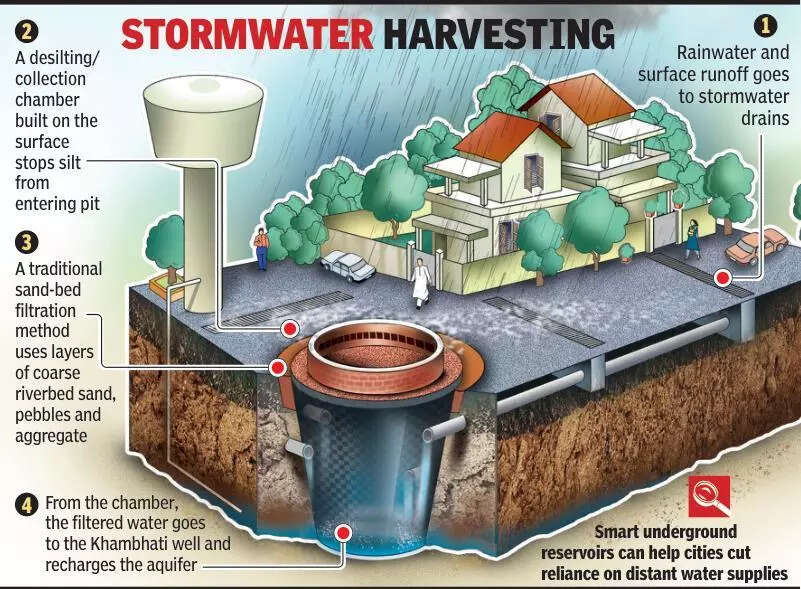
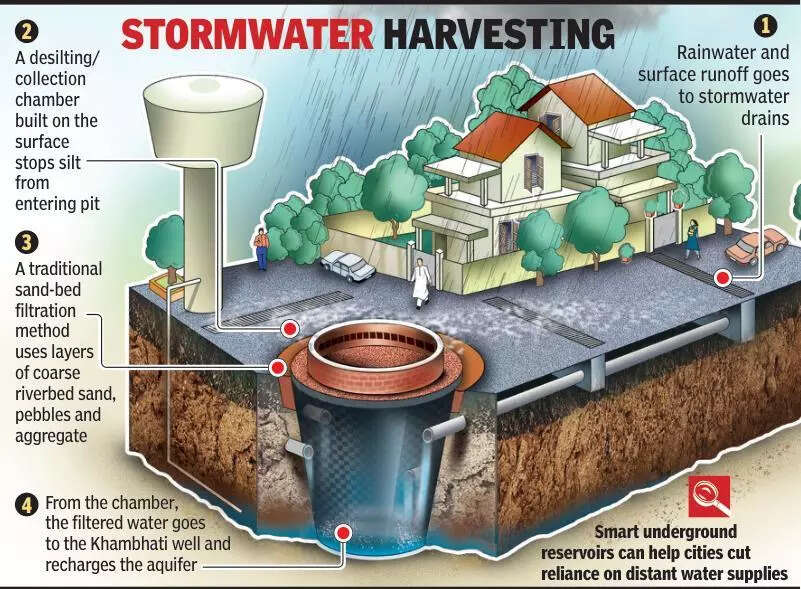
Ahmedabad: On the outskirts of the city in Rancharda, architect Rishit Shroff draws nine months of drinking water from a tanka, the traditional underground reservoir. “As per rules, the rainwater harvesting system has to be there. But apart from that, it is our duty too as citizens. We have consciously done that. There are six in my family.” His family uses layered filters and reports low TDS, proof that urban homes can lean on old wisdom.Across the town in Shela, homeowner Arpan Gadhvi has reworked an old bungalow on a large plot to capture and reuse rain. “It is an old bungalow with a large plot. We have used porous blocks on our plot. We use rainwater extensively, and we are recycling the water for gardening, so our net water usage is negative. We also spread awareness and invite our neighbours and acquaintances to show that it can be worked out.”What these households are doing in isolation mirrors a much larger shift taking shape across Gujarat—one where communities, and especially women, are turning personal initiatives into water-management systems. This year’s World Water Day theme, ‘Water and Gender,’ plays out on the ground from the Dangs to Mehsana, where women are reshaping how communities plan, measure, and share water.In Mehsana’s Diwanpura, Minaxi Panchal (45) moved from ASHA work to the Water Security Project under a CSR initiative in 2024 with the city-based Development Support Centre (DSC). She also took on neighbouring Bhasariya. Panchal’s team introduced village-level “water budgets”—linking rainfall, recharge, and use. They surveyed crop and livestock demand, measured pond capacities and irrigation practices, and adopted simple technology like rain gauges, flow meters, and cut-through flumes. Her push on groundwater-level monitoring, rainfall updates via messaging apps, and micro-irrigation (drip and sprinklers) has helped the two villages avoid the starts-and-stops that once stalled farming.Further south, Nita Patel of the AKRSP network has spent over a decade working with communities in the Dangs and adjoining districts, taking assured water to more than 30,000 households. “The district is often seen as a region with excess rainfall – but its hilly terrain is not very conducive for groundwater recharge.” When monsoon runoff vanishes by early summer, women used to walk kilometres for domestic supplies. Patel’s response blends local committees—with women as members—and small structures: farm ponds, check walls, and solar-powered mini lift irrigation. The outcome is basic but transformative—time saved, crops stabilised, and village institutions that actually track their resource.Contractor and rainwater-harvesting consultant Setu Shah argues even boundary walls can double as infrastructure. “In large spaces where we need catchment areas, boundaries can be made porous with think walls and used as a means for water harvesting. A wall can also be used as a storage device.”Back in north Gujarat, DSC director Mohan Sharma points towards farmers like Kailash Patel of Visnagar who have cut water use by changing on-field practice rather than chasing more supply. Line sowing and soil-moisture improvements trimmed her wheat requirement to 7.12 lakh litres from 10.4 lakh litres last year. She now mentors others, adding low-cost inputs such as vermicomposting to the mix.Also in Visnagar, Neelam Patel (34) — an MA and Community Resource Person (CRP) — works as a ‘bhujal jaankaar’ (groundwater expert), measuring TDS and pH, tracking rainfall, and presenting simple dashboards to village committees. The approach has produced water budgets for five villages, spurred farmers to build recharge wells, and nudged crop diversification and rotation—spreading risk while easing demand on aquifers.Each initiative is modest on its own, but together they sketch the outline of a state learning, slowly and practically, to live within its water means.