





Delhi budget 2026-27: Highlights | Delhi News
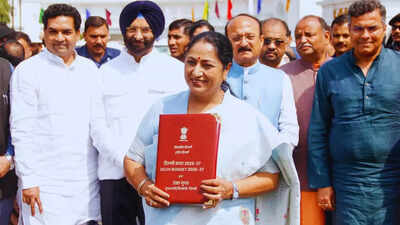
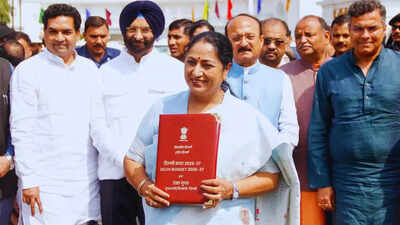
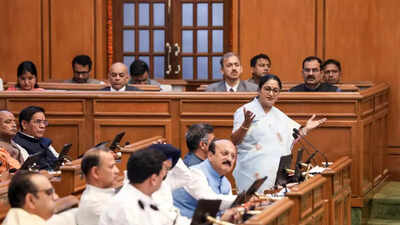
The Delhi government on Tuesday presented its Budget for 2026–27 in the Legislative Assembly, with a total outlay of Rs 1,03,700 crore — an increase of Rs 3,700 crore, or about 3.7 per cent, over the previous year.
NEW DELHI: The Delhi government on Tuesday presented its Budget for 2026–27 in the legislative assembly, with a total outlay of Rs 1,03,700 crore — an increase of Rs 3,700 crore, or about 3.7 per cent, over the previous year.Out of the total, Rs 62,550 crore has been allocated for schemes and projects, while Rs 41,150 crore has been earmarked for revenue and capital expenditure, according to the official release.
Where the money will come from
The government expects Rs 43,500 crore from GST and a total of Rs 74,000 crore from its own tax revenue. Non-tax revenue is estimated at Rs 900 crore.Additional inflows include Rs 3,931 crore from centrally sponsored schemes, Rs 968 crore as central assistance, Rs 591 crore from the central road fund,Rs 1,500 crore under the Swachh Ganga Mission, and Rs 100 crore for disaster management. The government also plans to raise Rs 16,700 crore through market borrowings.
Key spending areas
Education received the largest share of the budget at Rs 19,326 crore (18.64%), followed by health at Rs 13,034 crore (12.57%).Transport and roads have been allocated Rs 12,613 crore, housing and urban development Rs 11,572 crore, social security Rs 10,537 crore, and water and sanitation Rs 9,000 crore.
Green focus
A major highlight of the budget is its focus on environmental measures. About 21.44% of the total outlay —Rs 22,236 crore — has been set aside for green initiatives, including pollution control, expansion of green spaces, waste management and clean energy.
Infrastructure push
The Municipal Corporation of Delhi has been allocated Rs 11,266 crore, while Rs 5,921 crore has been earmarked for the Public Works Department and Rs 7,887 crore for urban development.Plans include redevelopment of 750 km of roads with Rs 1,392 crore and Rs 800 crore for unauthorised colonies. MLA funds have been set at Rs 350 crore, and new fruit and vegetable markets are also planned.
Water and sanitation
Rs 9,000 crore has been allocated to the Delhi Jal Board to improve water supply, expand pipelines and increase sewage treatment capacity from 707 MGD to 814 MGD.
Health sector
The budget earmarks Rs 12,645 crore for health, including Rs 150 crore for ICU and hospital projects, Rs 787 crore for medicines and equipment, and Rs 202 crore for expansion of the Ayushman scheme.More than 750 new health centres are to be set up, while Rs 25 crore has been allocated for the ANMOL scheme for newborn screening.
Education initiatives
The education sector has been allocated Rs 19,148 crore, including Rs 200 crore for new school buildings and Rs 275 crore for expansion.Other measures include Rs 90 crore for bicycles for girl students, Rs 10 crore for laptops for meritorious students, Rs 150 crore for smart classrooms and Rs 720 crore for technical education.
Welfare schemes
Under social empowerment, Rs 7,406 crore has been allocated to women and child development.Key schemes include Rs 5,110 crore for the Mahila Samriddhi Yojana, Rs 450 crore for free bus travel for women and transgender persons, Rs 260 crore for free LPG cylinders and Rs 128 crore for the “Lakhpati Beti Yojana”.
Transport plans
The transport sector has been allocated Rs 8,374 crore. The government plans to introduce 6,130 new electric buses, with a target of 7,500 buses by 2027.Metro expansion has been allocated Rs 2,885 crore, while Rs 200 crore has been set aside for the EV policy.
Governance and jobs
The government plans to set up 13 mini secretariats with Rs 100 crore, digitise land records and establish a new think tank named DITI.For industry and employment, Rs 48 crore has been allocated for MSMEs, with plans to train 32,000 enterprises and introduce semiconductor and drone policies.
Tourism and environment
The tourism sector has been allocated Rs 412 crore, including plans for an international film festival, installation of 1,000 modern toilets and city beautification.For environmental protection, Rs 300 crore has been earmarked for pollution control, along with Rs 204 crore for the Municipal Corporation to tackle pollution. The government also plans to enhance waste processing capacity and introduce a carbon credit scheme.