









More VCs make fabless bets as startups tape out chips | Chennai News
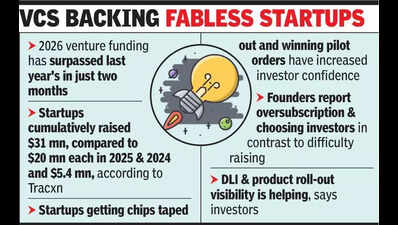
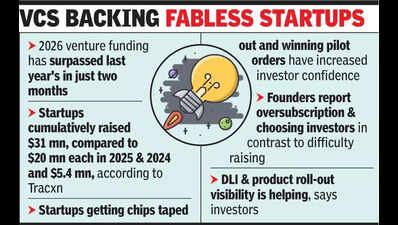
Chennai: Fabless semiconductor startups are drawing increased interest from venture capital, with an uptick in deal flow and cheque sizes, as they accelerate commercialisation—moving from design to tape-out and pilot orders.With $30.8 million in funding across four rounds in the first two months of 2026, the sector has already surpassed last year’s total. It raised $20 million in 2025 and $25 million between 2022 and 2024, according to Tracxn data. Ticket sizes are rising too, with VerveSemi and C2i each raising over $10 million in their latest rounds. The sector had so far witnessed limited interest due to the long gestation periods typical of deep-tech startups. However, more investors are now willing to back startups even at the Series A stage. This marks a shift in the nascent sector, which has gained momentum since 2022, driven by the design-linked incentive (DLI) programme. Industry experts attribute the shift to early movers securing test orders from original equipment manufacturers (OEMs). OEMs are already placing test orders with Indian vendors, said G S Madhusudan, CEO of InCore Semiconductors. “It is a natural progression as some move towards commercialisation and seek funds needed for the next stage of growth,” he said. He expects adoption to begin in electricity meters, smart cards, and chips used in consumer electronic devices such as washing machines, fans, refrigerators, power electronics, and industrial equipment.Anil Joshi, managing partner at Unicorn India Ventures, said there is a reasonable tailwind in the segment, and recent investment sizes are a clear sign of growing interest. “Companies that have been developing product designs over the last few years are ready for their first tape-out, and this gives investors visibility on product rollout. The government’s push under the DLI makes for a strong pipeline for investors,” he said. Pratap Narayan Singh, co-founder of VerveSemi, founded in 2017, said investor sentiment has changed in recent years, with the company’s latest round oversubscribed. VerveSemi reflects this trend—it has taped out 25 variants and aims to scale up, producing over two million chips from five variants by the end of the year. “Supply chain disruptions during COVID and geopolitical factors are driving OEMs to diversify sourcing, opening opportunities for Indian vendors,” Singh said. Shashwath TR, co-founder and CEO of Mindgrove Technologies, said ticket sizes have increased as more startups raise growth-stage funding, while even seed rounds are getting larger due to higher prototype development costs. “A few of us have moved beyond labs, and investors’ appreciation of the business model and actual risk-reward has increased,” he said. He added that startups are in early discussions with OSAT players, which could improve unit economics. Hareesh Chandrasekar, co-founder and CEO of AGNIT Semiconductors, said the company recently raised $2.6 million in a seed extension round to scale its two chips for volume production. While startups focusing on consumer applications are scaling up, AGNIT, which works on gallium nitride chips for strategic applications such as radars, said efforts to localise defence components are a key driver. For a semiconductor product startup to succeed, it must qualify and prove reliability before securing million-scale orders, which are broadly expected to begin from 2027.