










No criminal case against officials without proof of intent: HC | Nagpur News
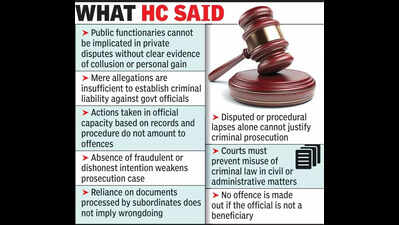
Nagpur: The Nagpur bench of the Bombay high court recently ruled that public functionaries cannot be implicated in criminal cases arising out of private disputes without clear evidence of collusion, benefit or intent, quashing proceedings against a revenue officer accused in a property mutation case.Justice Pravin Patil allowed a petition filed by Yashwant Panjabrao Chavan, a deputy superintendent of land records in Yavatmal, through counsel Anup Dhore, and set aside criminal proceedings pending before a judicial magistrate first class in Ner town. The case invoked offences under sections 420, 468, 424 and 471 read with Section 34 of IPC for alleged cheating and forgery.The court held that “public functionaries cannot be dragged into a private dispute by merely stating that they have acted in collusion with the co-accused persons, particularly when they are not beneficiaries”, emphasising the absence of any material showing personal gain or dishonest intent on the part of the petitioner.The case stemmed from a mutation entry approved in 2020 following an application by legal heirs of a deceased individual. The petitioner maintained that he acted in his official capacity, relying on documents including a legal heir certificate, death certificate and affidavits submitted by the parties concerned.Court records indicate that due procedure was followed, including issuance of a public proclamation on Sept 11, 2020, inviting objections. As no objections were received, and after a spot inspection conducted by subordinate staff, the mutation entry was sanctioned.The prosecution opposed the plea, pointing to alleged discrepancies in the spot inspection report and witness statements. It was also contended that affidavits were prepared on stamp papers of earlier dates, raising suspicion over their validity.The court rejected these arguments, noting that the spot inspection report was prepared by subordinate staff and did not bear Chavan’s signature. “It is but natural that these witnesses have stated that the same was not prepared by the petitioner,” the court observed, declining to draw adverse inference.Addressing the issue of stamp papers, the court reiterated settled law that their use is not restricted by time limits, stating “there is no impediment for a stamp paper purchased more than six months prior being used for a document”.Notably, the court found no allegation that the petitioner derived any personal benefit from the transaction. It held that “only because he has issued the order on the basis of documents produced before him, he cannot be prosecuted”, particularly when subordinate officials had processed and verified the records.Observing that criminal liability requires clear evidence of “fraudulent or dishonest intention”, the court concluded that no prima facie case was made out.Accordingly, the court quashed the proceedings, including the chargesheet and criminal case, insofar as the applicant was concerned, reaffirming safeguards for public officials acting within the scope of their duties.