






Conversion bill passed amid SC case on 12 other state Acts | Mumbai News
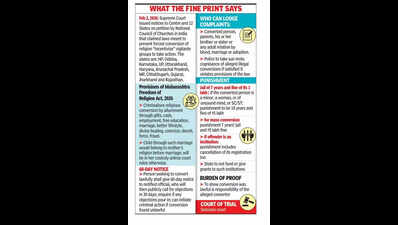
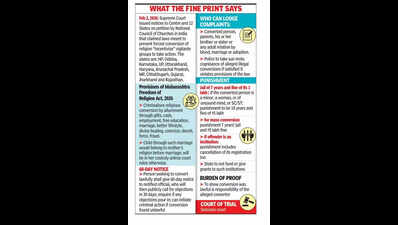
Mumbai: Maharashtra this week became the 13th state to pass a bill to prohibit unlawful conversions. Like Odisha, which brought in such a legislation first in 1968 and was followed by Madhya Pradesh and other states, criminalising religious conversions based on coercion, fraud or marriage based on allurement or deceit, the Maharashtra Freedom of Religion Act, 2026, too mandates a 60-day notice to a district magistrate before a person can convert to another religion.While the bill was passed by both houses of the State legislature on March 17 and 18 respectively, it now awaits the Governor’s assent and a notification in the gazette before it comes into force.Senior counsel and former additional solicitor general Indira Jaisingh said since a challenge to anti-conversion laws of several states is pending before the SC and has been on the daily board for days now, “Political good sense requires that Maharashtra govt awaits the judgement before notifying the law. Going ahead would convey great disrespect to the court while awaiting its opinion on a serious violation of the fundamental right to marry a person of your choice.“On Feb 2, the Supreme Court bench of Chief Justice Surya Kant and Justice Joymala Bagchi, in fact, issued notice to the Centre and 12 states on a petition filed by National Council of Churches in India, which claims the laws “incentivise” vigilante groups to take action.The petition filed against the State of Rajasthan and others raised concerns over such laws and questioned their validity. The matter is pending before a three-judge SC bench. Leading civil and constitutional rights lawyers say the law’s provisions could be tested if the basis for action under it is found to be vague. Senior counsel Mihir Desai in Mumbai on Friday said the Maharashtra Act too could be challenged before the SC.While ministers in Maharashtra justify the need to ensure religious conversions are voluntary and transparent and not forced or fraudulent, legal experts point to the Constitutional mandate under Article 25, which protects an individual’s right to practise, profess and propagate faith. Mihir Desai, a prominent civil rights defender, said the law is “to my mind incorrectly worded as ‘freedom of religion’ since it mandates prior notice and nod from authorities for any conversion in future even if it’s for pure freedom of conscience.“Terms such as ‘allurement’ and ‘undue influence’, while defined, leave the meaning and interpretation “broad-based”, said Desai and other lawyers, and “possibly susceptible to misuse”. Former Bombay HC judge Justice (retired) B H Marlapalle said for any criminal action to be attracted, the allegations would need to be specific, unlike what broad terms used to frame the legislation – allurement, ‘divine healing’, ‘brainwashing’, and ‘undue influence’ – would suggest.Lawyers and activists are divided in their reaction to the provision where a child born out of a marriage solely meant for an “unlawful conversion” would be deemed to belong to the pre-marriage religion of the mother, who would also have custody of the child unless court decides otherwise. Some call it progressive, others ‘divisive’ and impinging on the child’s rights.The Maharashtra Bill, naming no religions, referred to “increasing” instances of forceful conversions that affect “social harmony” and SC orders to say it’s subject to reasonable restrictions and the right to freely profess, practice and propagate a religion under Article 25 “doesn’t include right to forcibly convert”.