









Pune’s Green Spaces Scorched As Manmade Fires Go Unchecked | Pune News
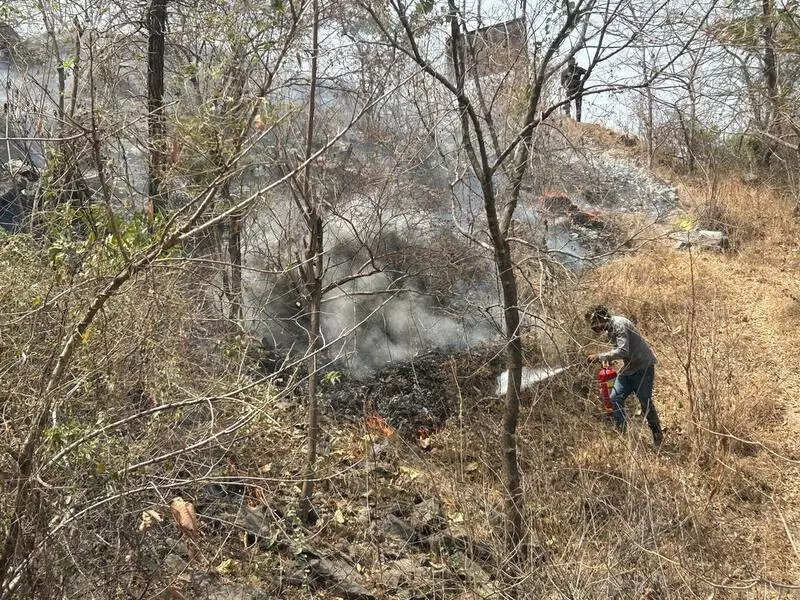
Pune: Alarming swathes of green cover have been lost in the city over the last few years in the name of infrastructure and redevelopment, despite active citizen resistance to many projects. The agitations to conserve precious heritage trees and biodiversity have left several potential work sites in the crosshairs of ongoing tussles, from the Ramnadi-Mula river confluence’s sacred grove to the Vetal Tekdi.Interestingly, in the last month or so, a slew of forest fires have been reported from some of these disputed locations, leaving citizens and activists fuming and casting aspersions. While they have no proof, a section of the green brigade claims that these fires could be premeditated to clear the spaces, rendering protests against destroying their greenery useless. It is not unusual for forest fires to pick up this time of the year. But citizens pointed out that their frequency is higher right now — almost daily in the case of some spots like Baner Hills — leaving them suspicious. Environmentalists also said they have long been reaching out to the authorities to improve the forest department’s firefighting facilities, but their constant pleas continue to go unanswered. Convenor of the group Citizens for Area Sabha Ravindra Sinha said, “We have been holding meetings with forest officials for nearly five years now, and the biggest challenge they face is lack of equipment and manpower to fight fires. State govt allocates a very small budget for the forest department — often reported as less than 1% — despite it having almost 60,000 sqkm of forest area to look after across Maharashtra. There should be some standard operating procedure (SOP) to prevent forest fires and take action against those burning garbage, starting fires and, most importantly, destroying thriving biodiversity. On-ground measures should be jointly implemented with local bodies.”Burning threat to sacred grove and its precious biodiversityDuring a routine nature walk on March 6, volunteers of the city-based NGO Jeevitnadi were shocked to discover part of the riparian zone near the Ramnadi-Mula river confluence gutted by a fire.Axing of trees or construction for the riverfront development (RFD) project in this section along the rivers had been prohibited in 2025 after citizens’ efforts forced authorities to change their plan to protect a sacred grove. “And yet, a stretch of at least 700-750m of the riparian zone near the confluence is burnt,” said volunteer Shubha Kulkarni, adding, “There have been similar incidents previously, but never this major. We have no way to know if this was deliberate. Small parties already happen here on and off, as smaller patches are seen burnt. But this time, it does not look accidental.” “It is difficult to get officials to monitor this area because they treat it as some sort of no man’s land. The police say that their jurisdiction ends on the road, and the ward office has not been helpful in keeping vigilance. Now, we as volunteers have decided to keep watch ourselves. We are going to the spot, sometimes even thrice a day, to ensure that there are no more fires and simply to keep vigil,” Kulkarni added.Highlighting official apathy, Jeevitnadi volunteers also gathered on March 15 to water the burnt area and put out the smouldering embers themselves. “Many old growth plants were struggling as the fire was right at their roots,” said Prajakta Mahajan, another volunteer.“Around 20 of us, from schoolchildren to senior citizens, filled our buckets with water from the local well and poured it over the burnt patches for moisture. We also used a water pump and big pipe to collect water from the river itself for areas that were far away from the well. This went on for two hours in the morning. We plan to do this activity periodically to save whatever remains of the trees,” she added.Kulkarni further said that it is currently mating season for several species that thrive in this area. “The fire has destroyed most of the Glycosmis pentaphylla (commonly called kirmira) shrubs, which are host plants for butterflies. There is also an owlet nest in that patch. Many insects and other species that are at the bottom of the food chain, but are extremely important to the overall ecosystem, are affected,” she explained, adding that these are the most affected by such fires. Frequent fires choke city’s lungs, Vetal TekdiThe popular Vetal Tekdi has for long been in the spotlight as a hotly debated zone for laying the Bal Bharati-Paud Phata Road, which would come at the cost of thousands of trees and precious biodiversity. In Feb, a fire broke out in this disputed spot, disrupting the ecosystem. Vetal Tekdi Bachao Kruti Samiti (VTBKS) member and hill regular Sushma Date told TOI, “A fire usually breaks out here every year around this time, so it’s not an unusual occurrence. What is alarming is the lack of preventive measures. A lot of miscreants use the tekdi for smoking, consuming alcohol, or having small parties. While they think it’s a lot of fun, even the smallest fire causes huge amounts of damage.” Dry leaves, lying around in abundance at the onset of summer, catch the flames rapidly, making the blaze difficult to control. “Small insects and soil organisms die in these forest fires, while roots of shrubs, trees and grasses get damaged. New growth of plants also gets affected,” Date explained. Urban apathy engulfs hills of Baner & PashanFor the last eight weeks, residents around Baner-Pashan hills, Sutarwadi and Sus hills are constantly dealing with forest fires and ensuing smoke. They said that while such fires have erupted often for almost two decades, the frequency right now has raised eyebrows. “Baner hill is a govt-owned pasture, but there is ongoing litigation for its title. Most of the Pashan-side hills are also either owned by govt or Pune Municipal Corporation (PMC). Sutarwadi and Sus are largely privately owned and even then, deemed as forests. On many of these hills, fires are often started purposely for fresh grass to emerge post-monsoon. Authorities don’t take measures to prevent, mitigate, or fight these fires,” said Pushkar Kulkarni, a Pashan resident. “The problem is that they do not see the cascading effect on biodiversity. Loss of species, groundwater recharge potential, heat and carbon mitigation, etc. are all stark realities, not to mention subsequent poor air quality for nearby residents.” “Fires also raise temperatures in the area. Shrubs and grass that help control the rising level of floating dust are the first to go when flames catch,” Kulkarni added. The resident alleged that in many cases, fires are lit to burn and get rid of garbage collected by gram panchayats and dumped here, because they claim not to have the resources to process it correctly. For years, there have been calls for de-reservation of patches of the biodiversity park (BDP) zone on Baner Hill for residential development. Pune’s southern gateway Katraj Ghat set ablaze again, entire hillside left charredFor three days in the second week of March, a fire raged on the hills near Katraj Ghat, leaving huge patches completely charred. Like other locations, fires are an annual occurrence here — local resident Vickrant Siingh volunteers to keep a check on these blazes and calls in the fire brigade when needed. He told TOI, “Grass burning is a common practice here as villagers believe the new grass will be better fodder for cattle. Garbage dumped here is also burned. However, the fire this month was severe. It looked like the whole ghat was burning. The full hillside looks black now. The fire brigade has its limitations. They can’t go into the internal parts, so the fire keeps raging there.”“It’s disappointing when this happens. Many residents spend considerable time cleaning these hills of garbage, planting saplings and nurturing them. Fires like these, mostly manmade, negate all our efforts,” the activist added. Siingh and his Katraj Ghat Swachhata Evam Samvardhan Abhiyan Team approached multiple authorities to rectify the situation, but to no avail. On March 12, Siingh met PMC commissioner Naval Kishore Ram and submitted an application about the fire. “If the broken retaining wall is rebuilt and the area is fenced, garbage dumping can be halted and the possibility of fires reduced. Authorities are simply pushing the buck, saying the matter does not fall in their jurisdiction. There is no coordination between Pune Metropolitan Region Development Authority (PMRDA), PMC, and the forest department,” Siingh added. Siingh submitted his first letter in this regard on Nov 14, 2025, to the assistant municipal commissioner of the Dhankawadi-Sahakarnagar ward office, under whose jurisdiction the area falls. In it, he pointed out that the forest surrounding Katraj Ghat is home to rich biodiversity, including numerous animal species and dense green cover. Previously, there were only three chronic dumping spots here; now, there are over 30. Each year, five to six fire incidents occur in this area, destroying almost half the forest cover and leaving scores of animals dead. His letter further suggested better coordination between all authorities concerned for a unified action plan, installation of lights, CCTV surveillance, daily cleaning and appointment of a permanent inspection team for regular monitoring and maintenance. Another key demand is for the creation of ground-level water reservoirs inside the forest to support wildlife and act as water sources during fire emergencies. ‘All forest fires are manmade’Mahadev Mohite, deputy conservator of forests (DCF), Pune, entirely rubbished the claim that forests catch fire when leaves dry out, highlighting that these fires are always manmade. Secondly, he admitted that the department is severely struggling with staff.“All these fires are 100% a result of human error. There is also a misconception that setting grass on fire gives a better yield next time, but this just deteriorates land in the long run,” he said.When a forest area catches fire, whether the land belongs to the department or is privately owned, officials get an alert to deal with it. “But in the absence of manpower, it is a cumbersome task. In 2012-13, we had about 5,000 permanent staff across Maharashtra. When they retire, their position lapses. Now, this number is well below 1,000; barely 30-40 in Pune limits. State govt gives us temporary staff, but it isn’t the same as they don’t know the area well or have the knowledge of permanent staff,” he told TOI, adding, “A major chunk of the staff is also assigned on duty in areas like Gadchiroli and Chandrapur, where fires are more frequent. In terms of prevention, we use temporary labour to draw fire lines etc., but as human interference has also increased, it is not enough.”